
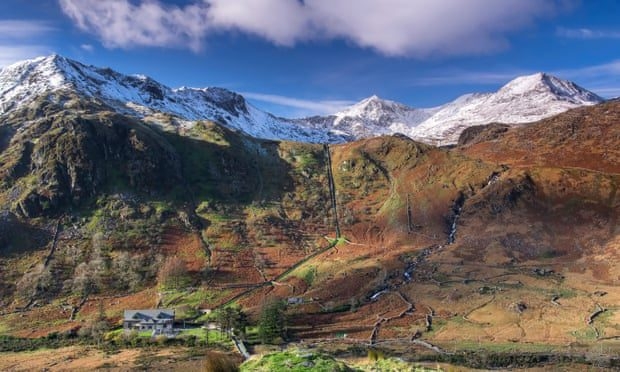
There’s been a lot of discussion this past week (on both sides of the border!) about a task group that had been set up to examine whether Wales’s highest mountain, known almost universally as its English name Snowdon, should be in future known only by its Welsh name – Yr Wyddfa.
The Welsh name ‘Yr Wyddfa’ means “the tumulus” or “the barrow”, and in folklore it is believed that the giant Rhita Gawr was buried on the mountain after his defeat by King Arthur. ‘Snowdon’ comes from Saxon “snow dune” meaning “snow hill’, a quite descriptive name, but by origin and definition, a much later naming of the mountain. . It’s been known as Yr Wyddfa long before the people of Wales spoke English.
The motion was brought by councillor John Pughe Roberts, who represents Corris and Mawddwy on Gwynedd Council, who proposed for the Snowdonia National Park Authority to refer to Snowden only by its Welsh name and also to use the Welsh name Eryri instead of “Snowdonia”. In the end, this move has been declined, but it has opened up a lot of underlying prejudices.
The words used for a place matter, both as a visitor and an indigenous people, and there appears to be an increasing understanding of the importance this. This is part of a movement to reclaim traditional Welsh names that have been Anglicised and follows the reclamation of the names of other colonised places such as Australia where Ayers Rock as named by white settlers has reverted to its Aboriginal name Uluru and Chomolungma, the Tibetan name for Everest (Its English name comes from Colonel Sir George Everest, a surveyor general of India – who, oddly in the context of this article, was born in Wales!) , is becoming an accepted name and not some fabricated colonial Anglicisation imposed by people too lazy to learn how to pronounce something correctly. New Zealand is a leading example of what has become a worldwide rediscovering of identity, where the Maori language is now taught in schools after centuries of repression, something that is happening in Wales on a growing agenda of confidence in the continued attempts at repression.
Indeed, even last evening, on the supposed guardians of equality, the BBC, we have a supposedly ‘funny’ show, Have I Got News For You mocking the Welsh language as unpronounceable. And ridiculing the Welsh language puts them at the cutting edge of comedy? A tired re-tread of amusement for monoglot racists. If this attack on the original language of these islands was an attack on, for example Bengali or Hindi, it would instantly be denounced as just that, racism, but here it’s deemed as acceptable? Guess it depends whether you have the intelligence to understand why it’s so offensive. Language is identity, with painful memories of colonialism and language suppression by the English still in the Welsh collective consciousness.
This has nothing to do with any Nationalist movement, it’s more about the richness and history of the use of a historic place name in an indigenous language. Strangely, it is the relatively new English language, an amalgam of numerous continental languages, and its speakers that seems to struggle with other languages and placenames, and, strangely enough, mainly with their nearest neighbours. And yet there is acceptance of most Welsh placenames, and even other mountains, so the argument that if it is known by its original name it will be difficult for non-Welsh speakers to pronounce is without foundation. I know from many experiences that some struggle with the ‘LL’ sound (Langolen?!!) but that really isn’t that important, at least there’s an acceptance. What matters is their original names are maintained and respected and we don’t continue down the worrying path of anglicising all of our landmarks and losing the heritage that is part not just of Wales but the British Isles. When you see places such as Southwark or Leominster and their pronunciation, you don’t hear any protests from this side of the border!
Without a doubt, I think all Welsh place names should be in Welsh only. People would get used to calling them by just that name and we wouldn’t have to waste money printing two names on every sign, after all, yu never see that in other none-English speaking countries. Not only is Snowdon ‘Yr Wyddfa’ but our country is ‘Cymru’ (land of the comrades) not ‘Wales’ (land of the outsiders).




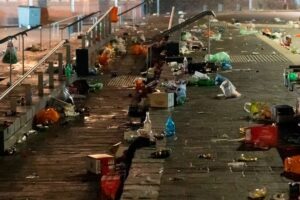 The Police, Crime, Sentencing and Courts Bill, which propose to give police in England and Wales more power to impose conditions on non-violent protests, including those which are deemed too noisy or a nuisance, is to me an act of fear by a morally bankrupt Government being put in place to discourage any resistance to the damage being done by them, and to maintain a power base that can go unchallenged. But the use of violence and anti-police activity to counteract its imposition is actually playing into their hands. They have, in the full view of those who do not attend such gatherings, the reason to use harder laws to supress what seems to those on the peripheral, an attack on law, and by proxy, on their way of life. Simply, peaceful, non-aggressive protest would, and remains, the best way forward, however difficult it may seem.

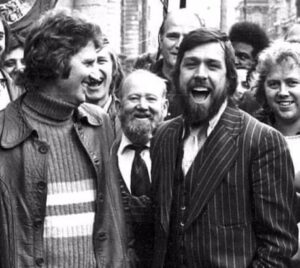 Twenty-four trade unionists who picketed during the 1972 national builders’ strike and were subsequently convicted for their actions have finally been cleared of the trumped-up charges including unlawful assembly, conspiracy to intimidate and affray.


 If you haven’t seen it yet, I would recommend The Mauritanian, a movie about Mohamedou Ould Salahi, and his fight for freedom after being detained and imprisoned without charge by the U.S. Government in the notorious Guantánamo Bay concentration camp for what turned in to 14 years.This isn’t a one-off, 780 men have been incarcerated there, out of which only seven have been convicted, including five as a result of pre-trial agreements under which they pleaded guilty in return for the possibility of release from the base.
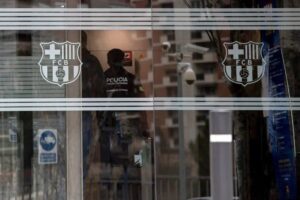 A police raid at Barcelona? In this case it seems to be related to the ‘Barcagate’ scandal in 2020 when the club denied hiring a firm to attack their own players on social media.Barcelona have said the police searches related to the “contacting of monitoring services on social networks”.
 Zhang Zhan, a Chinese journalist who reported from Wuhan during the early stages of the pandemic, was sentenced to four years in prison after being accused of “picking quarrels and provoking trouble.” Like we should expect anything different from China?


